Paper projects with a clear finish
Paper is the most honest medium for an adult beginner. It requires neither noisy motors nor chemical solvents, and high-grade 140 gsm printmaking paper behaves with predictable structural rigidity. When handled with precision, paper folds, binds, and encases objects with furniture-grade stability.
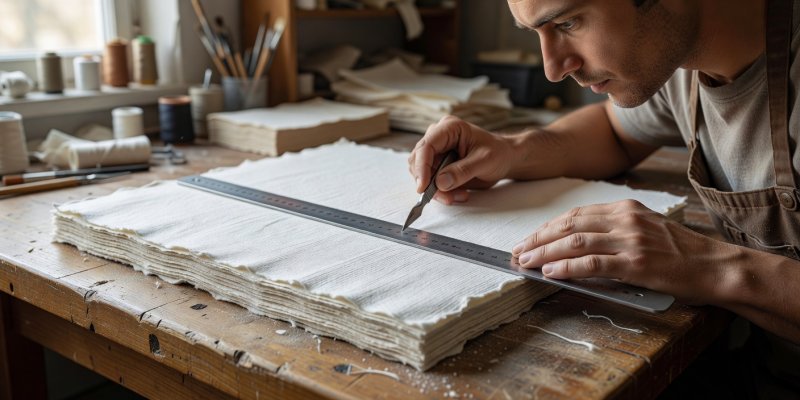
Understanding the Paper Grain Direction
All machine-made paper possesses grain: fibers line up in the direction the slurry moved on the mill conveyor. Folding paper parallel to its grain results in a crisp, sharp hinge. Folding across the grain ruptures fibers, causing unsightly buckling and rough fissures.
To detect grain without specialized tools, gently bend a sheet between your palms horizontally, then vertically. The direction offering least resistance is grain long. In hand bookbinding, book page grains must always run parallel to the spine; otherwise, moisture from adhesive causes leaves to curl inward irreversibly.
The Three-Hole Pamphlet Stitch: Foundations
Before attempting multi-signature hardcovers, complete a pocket notebook using the historic three-hole pamphlet stitch. It requires five sheets of unlined paper folded into a single signature (ten leaves, twenty pages), bookbinding linen thread (35/3 weight), beeswax, a sharp bookbinder awl, and an ox-bone folder.
| Step | Action Protocol | Critical Checkpoint |
|---|---|---|
| 1. Punching | Pierce center hole, then punch top and bottom holes 25 mm from edge | Keep awl strictly vertical inside the spine trough |
| 2. Threading | Pass needle from inside center hole out through the spine | Leave a 7 cm interior tail for the finishing knot |
| 3. Loop & Return | Enter top hole inward, run full length out bottom hole, re-enter center | Ensure thread straddles the central bridge cord |
| 4. Binding Knot | Tie square reef knot firmly across the center span; trim to 1 cm | Check that page leaves do not pucker under excessive pull |
Building Archival Slipcases & Folios
Once stitching feels natural, move toward making archival document boxes from acid-free greyboard (2 mm caliper) and book cloth. Use cold polyvinyl acetate (PVA) adhesive diluted with 10% wheat starch paste. This adhesive blend provides sufficient open time to position book cloth smoothly before setting, eliminating stubborn air bubbles without soaking the board.