Hand stitching for everyday use
A mass-produced sewing machine operates with two threads locked into a fragile loop at the seam center. If the top thread abrades against rough concrete or friction, the entire seam unravels in seconds. Hand sewing — specifically traditional saddle stitching — interlocks twin needles independently, creating seams that survive decades of heavy handling.
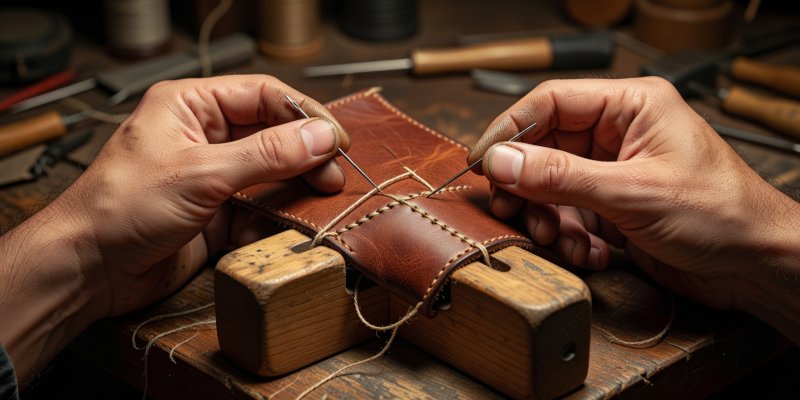
The Anatomy of the Saddle Stitch
To execute a consistent saddle stitch, holes are prepierced with pricking irons (diamond or French slanted chisels) struck lightly with a wooden mallet. You do not force needles through raw leather with finger strength alone.
Clamp your leather workpiece into a simple desktop stitching pony. Thread both ends of a single length of waxed thread into blunt harness needles. Pass needle A from right to left, then needle B from left to right through the exact same channel. Cross the threads at an angle and pull both ends outward with uniform muscle tension. This rhythm generates angled, beautiful slant stitches on both faces of the article.
Japanese Sashiko for Utility Garment Reinforcement
Sashiko originated among Japanese agricultural communities who reinforced worn work jackets (noragi) against cold and wind. Rather than concealing a rip, sashiko utilizes thick matte white cotton thread to bind patching fabric across stressed denim or linen.
The Running Stitch Rhythm (Unshin)
Unlike Western embroidery where each stitch is pulled through individually, Sashiko relies on loading five to eight running stitches onto a long needle simultaneously. Using a palm-ring thimble, push the needle eye through the bunched fabric before drawing the thread through all folds in one fluid movement.
Thread Tension & Puckering Prevention
Never pull sashiko stitches drum-tight. Leave a relaxed loop of thread at each 90-degree directional turn on the fabric reverse. After mending, wash the garment in cold water: cotton fibers swell and bed permanently into the weave, locking the patch in place without puckering.
Edge Finishing: Burnishing vs Edge Dye
Vegetable-tanned leather edges can be finished without toxic acrylic coatings. Sand the edge flush with 400-grit silicon carbide paper, apply a dab of gum tragacanth or water, and rub briskly with a grooved hardwood burnisher. Friction heats the natural tannins, welding fibers into a glass-smooth, water-resistant sealed profile.